How AI should be used in Finance
Redesign Finance First
Step into the shoes of a CFO at a multi-billion dollar company, who’s been asked to figure out where AI could help in finance. Like any good leader, you've done your due diligence over the past couple of years and you've rolled out a bunch of tools alongside some training: a copilot for your whole finance function, a couple of point solution tools for AP and expense report review, and a custom GPT for your finance policies. Unfortunately, month end close still takes 18-22 days. When you ask your finance team for their perspective, they explain that the new tools haven't really helped and that the hours they're putting in come from handoffs and double and triple checking each other's work.
We’re going to walk you through how you could redesign your finance function to fix this problem. We’ll cover how we would extract the as-is process from your ERP, what steps we would remove first, how we would automate the process with agents, how we would make sure your people are still involved and what a successful function-wide roll out looks like.
What a typical process looks like
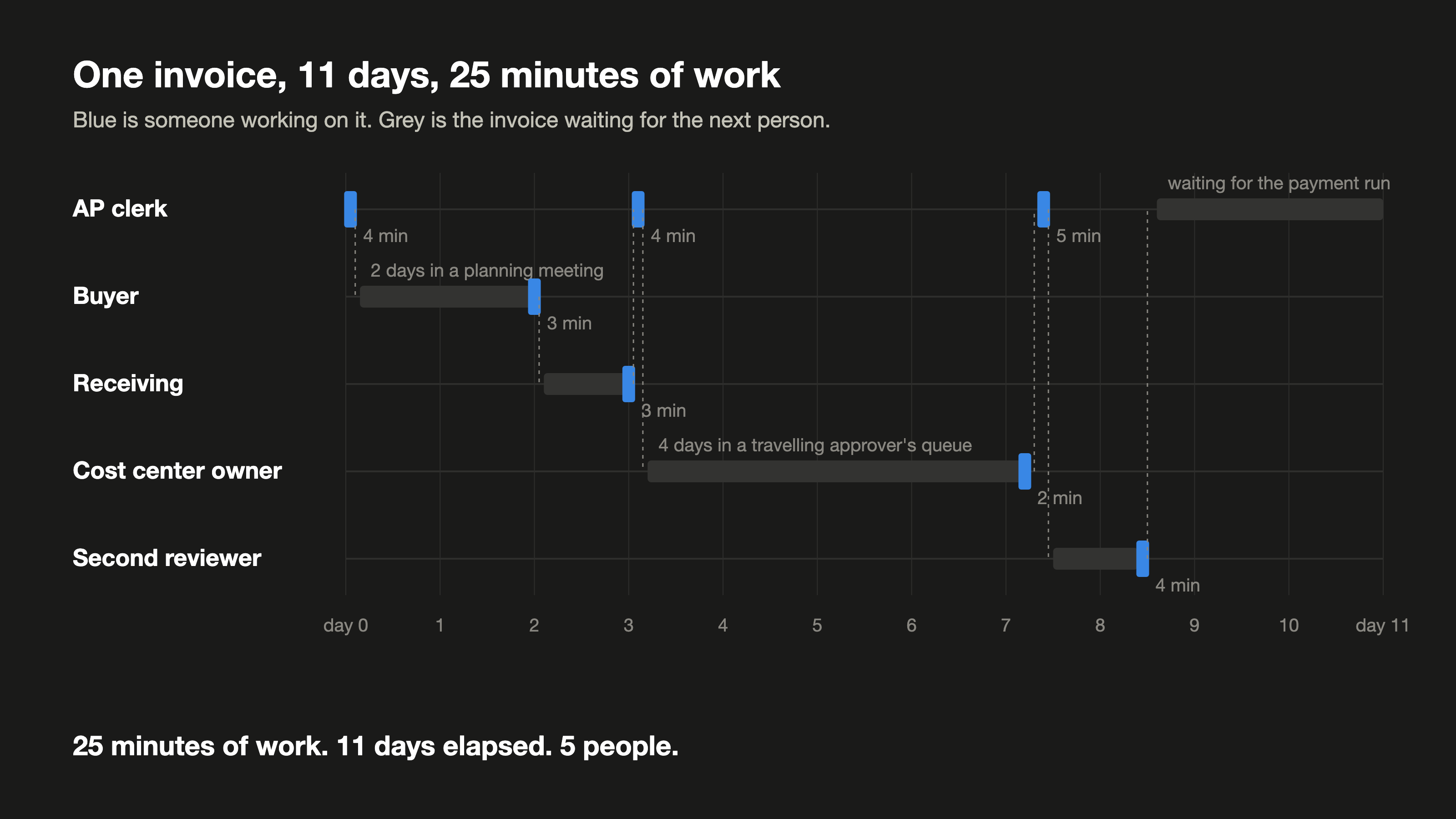
Consider a $48.2K invoice from one of your packaging suppliers. Procurement left freight off the $46.9k PO, so it was added back at the header level, while the goods receipt was done at the line level. The supplier always bills by the case, but the PO was done by units. Unfortunately, the three way match isn't going to work here.
To resolve this, the AP clerk emails the buyer to find out what the freight was. After two whole days (because the buyer is in the middle of a planning meeting) the clerk finally gets a response, which allows them to then email Receiving to confirm how many units were received and send it to the cost center. After another four days in the cost center owner’s queue while they travel, the invoice is finally sent back to AP - where it has to pass through a second review, and can only be sent out in the next payment run. Despite 25 minutes of actual work, the entire process ended up taking 11 days.
A finance function might process 600-800 of these a month. It's a lot of work that isn't difficult, but is rife with waiting, chasing, re-keying and re-checking. This means that the tools you've rolled out can only help speed up 25 minutes of work.
For context, Varick works with extremely large companies (with $1B+ in revenue, 1k to 100k employees), helping them adopt AI, from general strategy, to process re-engineering, to building, deploying, and managing their agents.
 Tap to enlarge (opens the full-size image)
Why tools stall
The main reason why tools don’t result in saving companies a meaningful amount of time is because they're all built for the average company - which doesn’t actually exist. While your AP process might have 7 steps in it, and 20% of your invoices are exceptions, the tool was probably designed for a 4 step process with exceptions that don't match yours. So it’s great at helping you with the 80% of your invoices that don't cost you much while people end up routing the 20% of your invoices around the tool, resulting in minimal ROI.
The second reason is that most AI tooling rolled out are all sidekicks, designed to sit next to you and help you 10-20% faster. What’s actually needed in a workflow like this are background agents, which are able to run autonomously, read all the invoices that come in, process the ones that can be reconciled, and only bring the exceptions and judgement calls to the humans. These background agents are the only solution that is able to drive a 60-90% improvement in a workflow.
ERPs are your guide
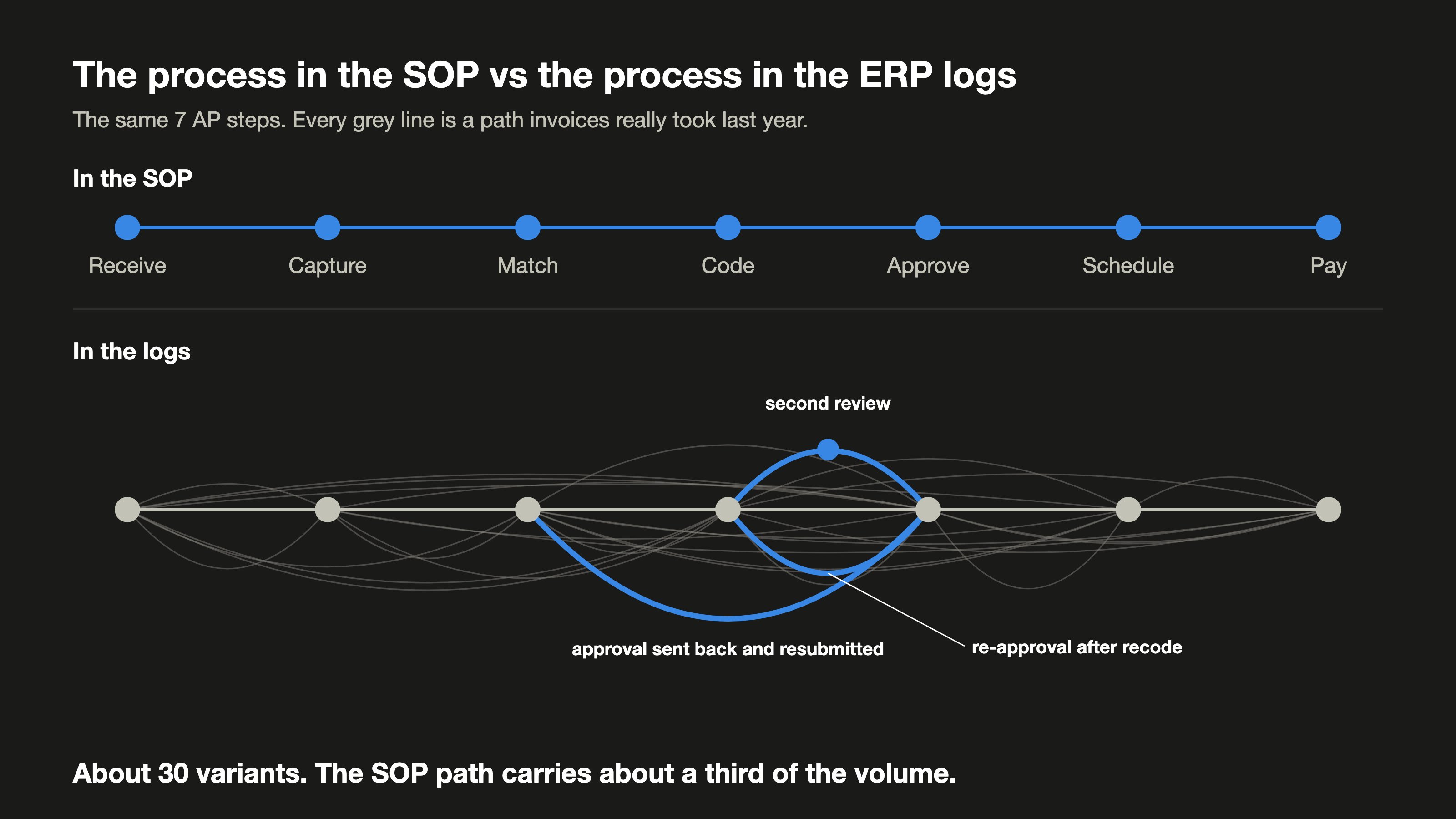
Asking people how they do things is entirely the wrong question - you should be digging through your ERP. In NetSuite, SAP, Oracle, Dynamics, etc. you will be able to access all the event logs that show the time and user of each action. This will let you process mine and find every path that any invoice took in the last year. Process mining is super boring stuff, but super valuable. The output looks something like this:
 Tap to enlarge (opens the full-size image)
These invariably show:
- Tons of rework, e.g. invoices being reworked 4 times before posting because of changes to coding after approval, which then need to be approved again.
- Tons of approvals being sent back and re-submitted to the same person, often for a reason the AP clerk could have fixed if the rule were written down anywhere.
- Pointless second levels of review that exist because of one mistake made years ago and are owned by no one.
- Many steps involving highly manual processes operating out of one person's spreadsheet (e.g. accruals during close).
- The 20-30 variations on the process compared to the SOP
You also need to baseline all key metrics: what does it cost to process each invoice (including all the rework from above), how many exceptions per month, invoice to payment time, straight through processing rate, days to close, DSO, etc. You need to take these to the finance people and get agreement on these numbers and on what success looks like in each of the 3 buckets (either you save time / money, or you make more money after paying the token spend, or you mitigate risks). You’ll need these when you go to the board in 7 months and show them the ROI on the project. Do not under-estimate the importance of getting agreement on this. If you do, you will end up having an unproductive argument about how much you saved/made vs. how much you spent on the project.
Redesign before you build
This is super important, and many people go straight to building. What you will find is that you have processes with 15 steps in them. If you build agents to do these 15 steps, you are spending a lot of tokens to do something that should actually take 5 steps, 4 of which can be automated by agents.
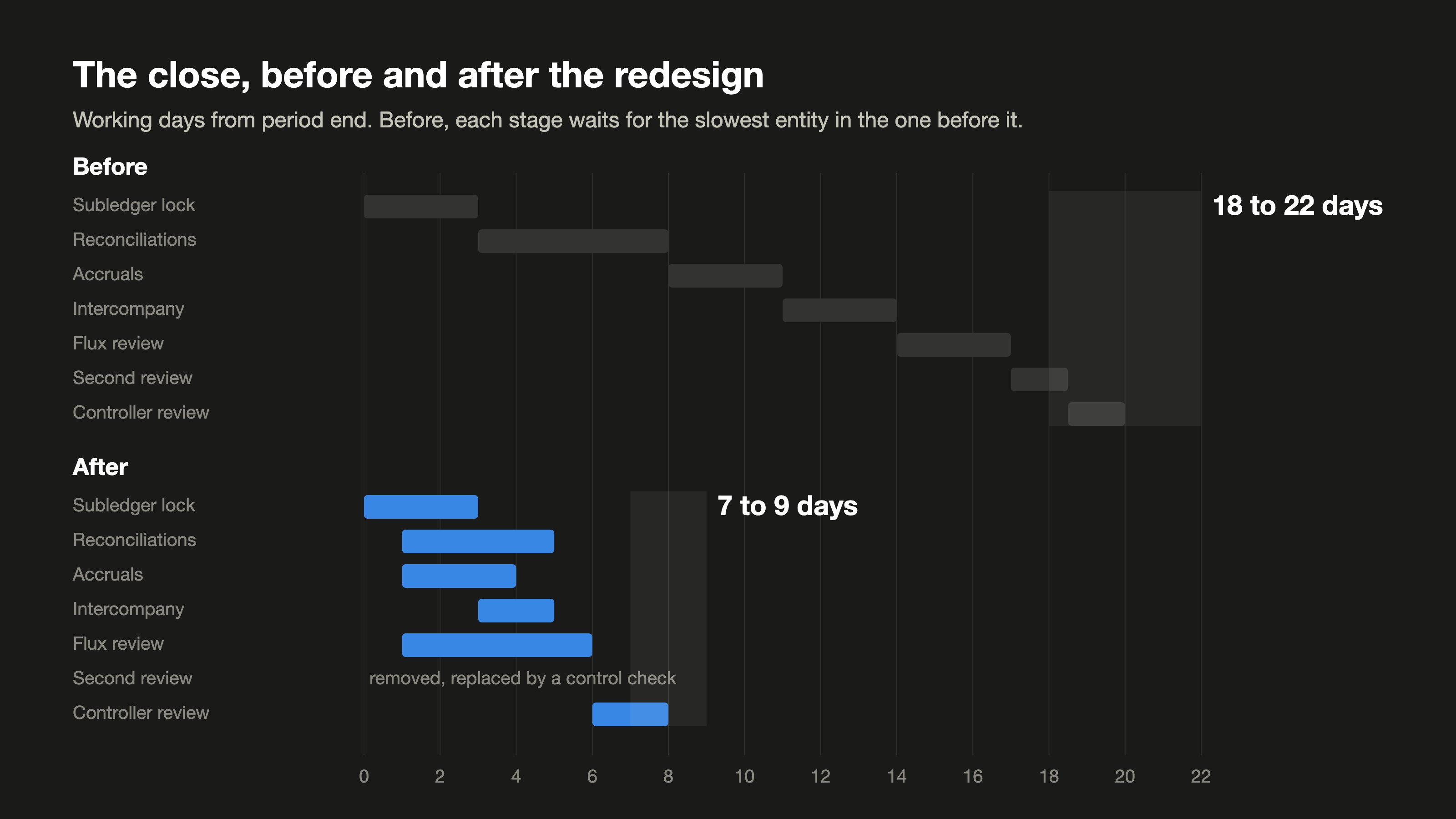
Here's a specific example. Most finance teams we see have a close process that takes 18-22 days, and it's a long line of processes where they close the subledgers and then on day 3 they start building all the recs for all entities. Then they do accruals, then interco, then flux review, then controller's review, etc., etc., where each step starts after the slowest entity finishes the prior step. Instead, what you should do is have the recs be built for each entity as soon as that entity files, with every break flagged alongside its evidence. Furthermore, the agents should build the commentary for all fluxes over a certain % or $ and link to the JEs that explain the fluxes, so that someone only has to read and edit the commentary. At the same time someone should be signing off on the accruals, which should no longer be a spreadsheet that 1 person updates, but a process which the agent does and someone signs off on. You should be able to remove some of the pointless second reviews that you identified while process mining, but replace them with control checks that the auditors will be happy about. Done in parallel and checked once, we've seen the same work close in 7-9 days. And the point here is that it's important to redesign the process, not just automate what you're doing today.
 Tap to enlarge (opens the full-size image)
Most finance AI projects blow their budget on how the agents get built. Agents for finance should be built mostly without AI. ~85% of the code should be hard-coded, only reserving AI for areas that need human judgement (e.g. reading a vendor's email to understand a short shipment, or writing flux commentary, etc.). If you do this right, you will get very high accuracy, and you won't burn $'s on 7-figure token costs.
Agents on the systems you have
You'll be running an ERP for a lot longer than most AI companies are going to be in business. Read & write to NetSuite, Oracle, SAP, Dynamics 365, Sage Intacct, Coupa, Ramp, spreadsheets, and whatever else you're using. The most common finance agents are:
- Accounts payable. Match invoice-PO-receipt, code, and route to the right person for approval. Impact: # of exceptions, cycle time.
- Cash application. Match payments to invoices, determine reason for short pays, and create draft collections. Impact: unapplied cash, DSO.
- Close & reconciliation. Automate bank and BS recs as soon as a new entity is ready to close. Impact: # of days to close.
- Flux commentary. Draft commentary for all fluxes above your threshold, linked to the journal entries. Impact: # of hours in review.
- Vendor onboarding. Run all checks (tax, bank, sanctions, etc.) and onboard directly into the ERP. Impact: time to onboard, avoid payment fraud.
- Controls & audit. Continuously test transactions against your control matrix and automate collection of evidence for the auditors. Impact: # of hours in audit.
These are all running on the same platform and share context between each other. Most companies we talk to are using "AI" to automate a specific task as a point solution, like an AI accountant for a specific thing. That's limited by the capacity and context of the accountant doing the task. Most short pays are due to pricing disputes in sales or credit memos that haven't been applied in AP, so an AI cash application accountant that operates in a silo can't see why the customer short-paid. In order to get full value, all of the agents across your function (and eventually the rest of the company) need to be on the same platform with a single pane of glass to operate and collaborate in.
Keep people on the decisions
You may be wondering, “what will my team do if agents are doing all of their work?” Well, for the 90% of the work that’s repetitive, the agents will do it. For the remaining 10%, your team will still be needed to apply judgement. The % that requires judgement may change over time as the agents learn from your team, but certain tasks will always need to be done by your team, like approving transactions and releasing payments. All postings will be subject to your authorization limits, and all agent actions will be logged so that “because the AI told me to” is never an acceptable answer for the SOX auditors.
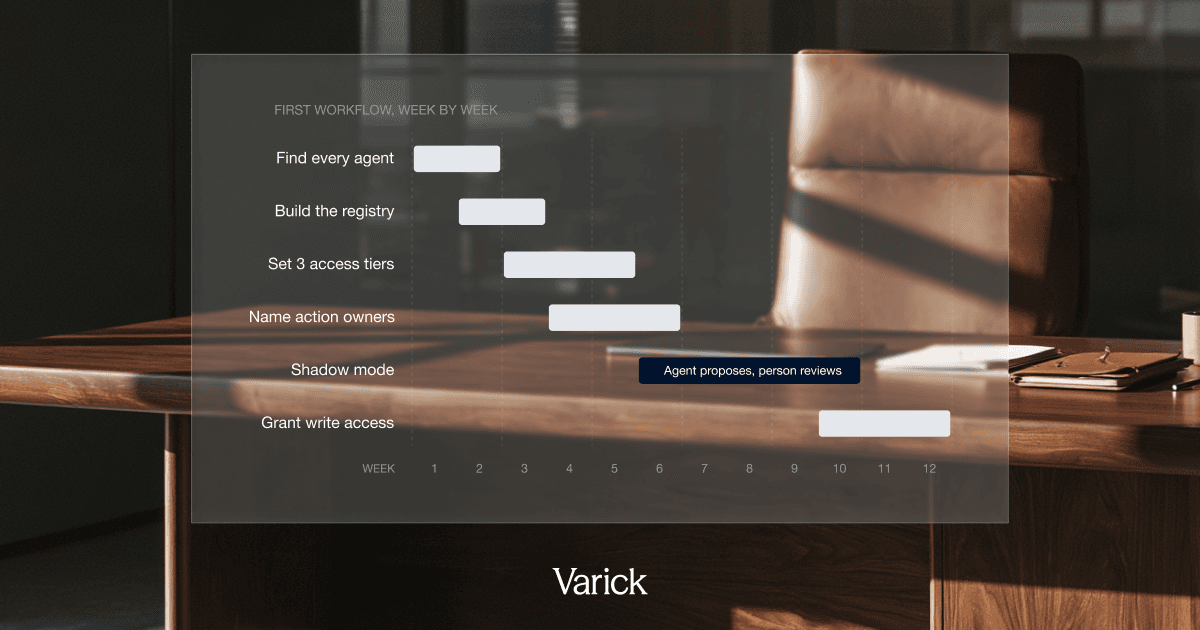
We always run the agents in shadow mode to ensure they’re posting what your team is posting. Once they’re ready to go live, your team will simply be handling the exceptions, which will come to them ready for action with all the info they need regardless of how many systems you have. Your team’s jobs will change as they’ll need to learn how to manage the agents, so you need to educate them before you start your implementation. It doesn’t matter if your AP clerk has been keying in invoices for 10 years because that’s not going to be their job anymore. Thankfully, we’ll be there to help them acclimate.
What a successful rollout looks like
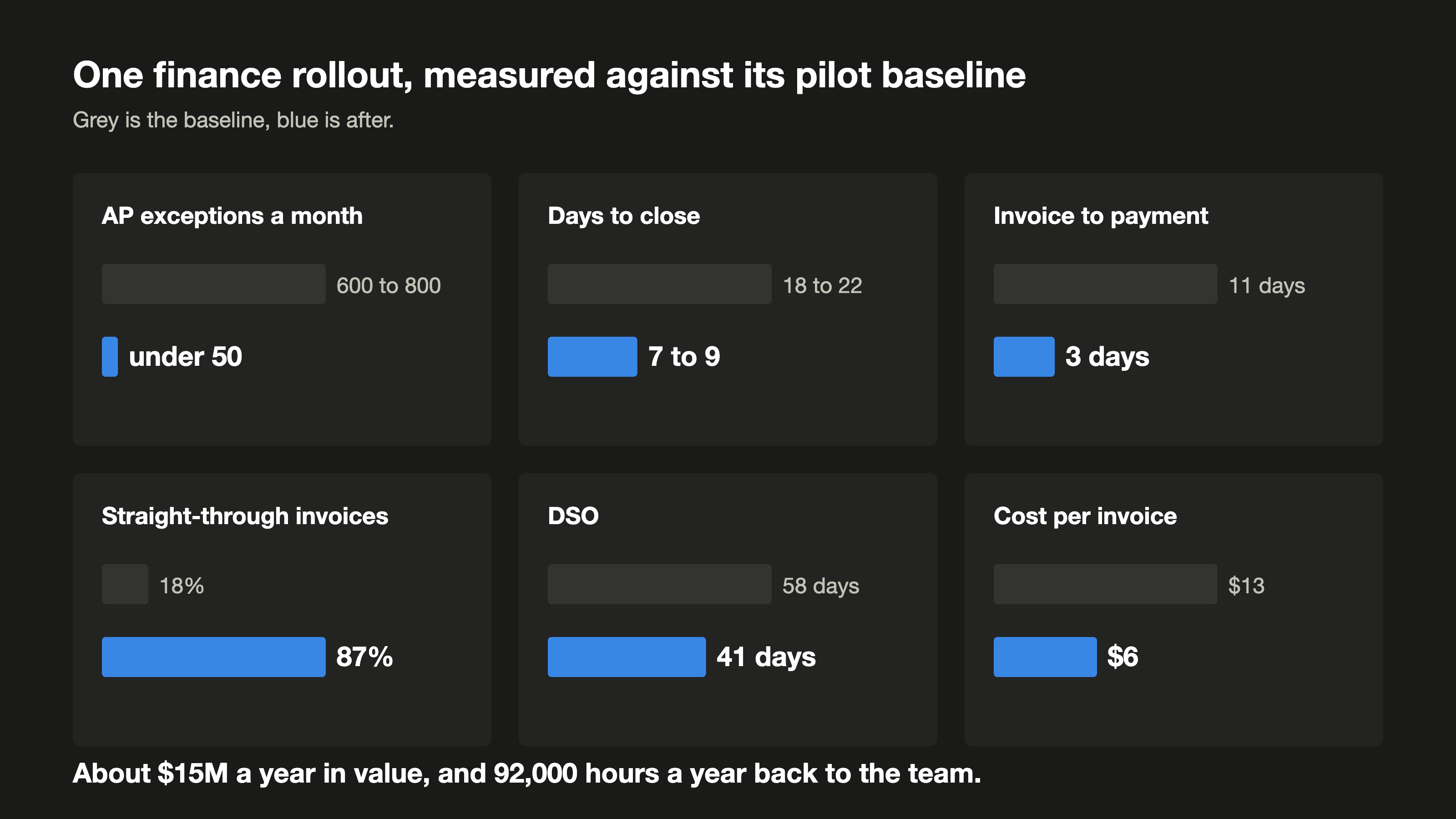
Here's what one finance function-wide rollout looked like once it was measured against its own pilot baseline:
- AP exceptions: 600-800 a month to <50
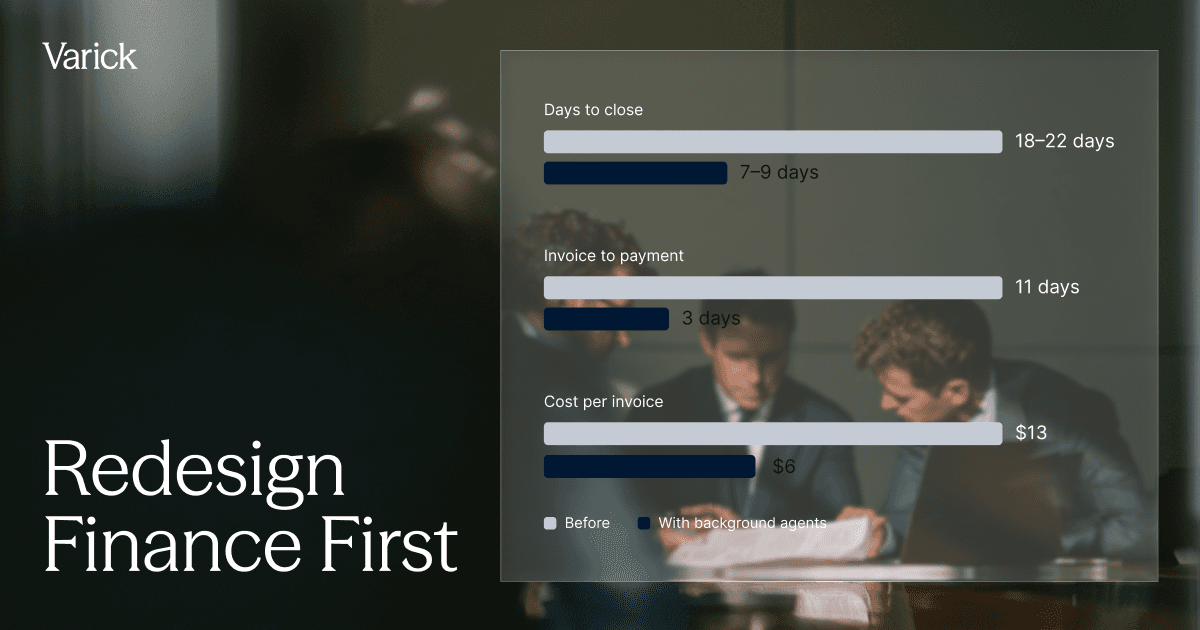
- Days to close: 18-22 days to 7-9
- Invoice to payment: 11 days to 3
- Straight-through processing: 18% of invoices to 87%
- DSO: 58 days to 41
- Cost per invoice: $13 to $6
Overall, the finance function ended up saving ~$15M in value and 92,000 hours a year.
 Tap to enlarge (opens the full-size image)
So, say your company processes ~40K invoices/month in AP. At $13 per invoice, that's $6.2M/year to pay your suppliers. At $6/invoice, it's $2.9M, so the AP agent alone is worth over $3M/year, not including the impact on close, and working capital from 17 fewer days of DSO.
Why finance transformations are difficult to find
The reason why this doesn’t happen often is because no one is doing the boring work of mapping all the exceptions. Traditional firms (roadmaps, maturity models, TOMs, 300 page decks, etc…) don’t stick around until your agents are in production. The AP tool vendors (the largest subset of finance AI in the market) have no interest in going beyond their 1 slice of the workflow and thus can’t see the entire pie. The sidekicks simply report on their logins, irrespective of your close. Now, the AI companies are jumping into the enterprise space, but they don’t know your specific processes and won’t go deep with your AP team.
This is dirty, detailed work and it’s where the money is. And, you’re likely to hear “we already did a process review 3 years ago.” And you may actually have - but it’s probably in a binder somewhere with no actual changes being made.
Work with us
We’re actively working with companies from $1B+ in revenue across Finance, Sales, HR, Procurement, Ops and IT. In finance, our companies start with a 4 week pilot where our forward deployed engineers mine your processes (from your ERP) and baseline your cost per invoice, exceptions, days to close, and prove a fix. Your first agents will be live 8 weeks from today, and you’ll own them at month 6. If your close is longer than 10 days or you have more than a few hundred AP exceptions, let’s talk here.
TLDR - here’s the way to cut your finance hours:
A typical exception in an invoice (freight not on PO) takes 11 days but only 25 minutes of actual work to resolve with 5 people. A normal function has 600-800 per month.
Copilots and point solution AP tools reduce the time per exception (down from 25 minutes) but they don’t reduce the time to resolve (11 days). If you’re looking to reduce your hours, you should be looking at background agents (60-90% reduction). If you’re buying a generic tool that assumes your AP process is 4 steps (it’s probably 7), your ROI is severely capped.
Start by mining your ERP to understand the processes and where the rework is. Who is re-reviewing? Is there an accruals file? What’s your cost per invoice, exceptions, days to close?
Re-engineer your finance function (15 steps becomes 5) and deploy agents (which can handle 4 of the 5 remaining steps), which run on your existing ERP, and leave the approvals and push to payment to your team. Shadow test your agents vs your team’s postings.
Done properly, exception volume drops from 600-800 to <50, your close goes from 18-22 days to 7-9 and your cost per invoice drops from $13 to $6.
Last updated